Has content production *really* changed in the last 12 months?


As we approach year-end and projects face that inevitable push-off to new year, it becomes a natural time to reflect on the year that’s been.
2025 made A LOT of noise about change. We saw clients (and the entire market) hit with decision paralysis, unwilling to commit to new hires, agencies, marketing channels, or even product roadmaps. I would say that despite all the noise about change, there was also a lot of sitting-on-hands. Organizations were mostly waiting for the other shoe to drop.
On our (agency) side, we don’t have the luxury of waiting for the other shoe to drop. Clients hire us specifically to be on top of things and lead them through change. So, we can’t sit on our hands waiting to see whether it’s AEO or GEO, what future attribution models will look like, or what the big seismic changes in marketing will be. We need to keep moving forward and drive immediate and ongoing impact for our clients.
On the content side, it’s interesting to reflect on what that has REALLY meant. Because while I have talked pretty much nonstop with clients about LLMs/AEO, when I sit down to do actual content production, things are more or less as they’ve always been.
The TL;DR is if you were good at content marketing before, you probably kept on keeping on, with minor tweaks to your thinking and workflows—despite what the ‘transformation chatter’ may have led you to expect this year. It was a lot less cha-cha-cha-changes and much more sa-sa-sa-samesies.
Here’s what I’m really doing now:
The same
Starting with a kickass outline
I’ve said it before, and I’ll say it again: Structure and flow are key. You can ask AI to create outlines for you, but I’ve found it’s actually terrible at it. It will give you most of the key sections, but the flow piece is often janky. It’s like asking it what furniture belongs in a room, versus where to place it (it can mostly list the furniture; it hasn’t a clue about the placement).
My first step when writing is always jotting down my H2s and H3s. Then I colour in between those lines in no particular order (often the last thing I write is the intro). I still do this. And I still prefer to do it myself.
Structuring the piece clearly
Tied to the outline is the use of H2s, H3s, and H4s. A lot of SEOs made a big deal about this (semantic chunking) earlier in the year as if it were a brand-new thing. As if we were all writing Beckettian prose without paragraph or line breaks before.
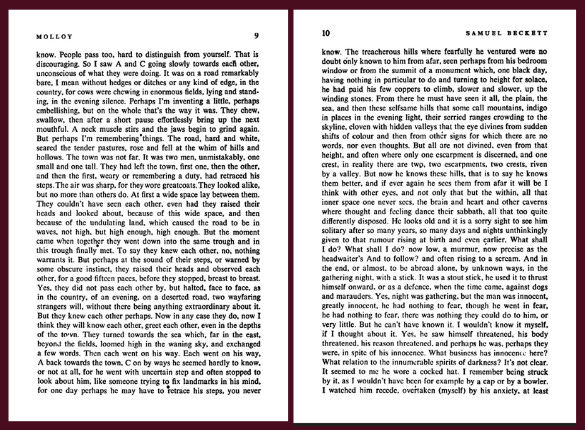
But of course, we content marketers could never pull off Beckett’s antics. We were already writing for readability: Using heading styles and bullet-point lists to help skim-and-scan readers, both to optimize for SEO as well as reader experience. This hasn’t changed for me: Did it before, still doing it…
Avoiding weaselly language (esp. around product)
Another of my constant bugbears is vague product throws. Often at the end of a piece, they’ll suddenly introduce the product in some “And that’s where [Brand] comes in…” manoeuvre. Then they’ll talk about the product in vague, product-marketing jargon rather than crisply and clearly explaining how the product addresses this particular problem at all. And failing to cite/point to case studies or data to prove its efficacy.
Granted: There are times when the connection is tenuous and vague, and a vaguer CTA might be your best friend. But I’ve always fought this as an absolute last resort, and I continue to fight for product clarity and a lack of weasel words in my writing.
E-E-A-T considerations
Long before AEO/GEO was a thing, we knew the importance of E-E-A-T to SEO. So, E-E-A-T considerations haven’t changed for me: I still inject my content with as much E-E-A-T as I can get from the client, their data, and product marketing materials.
The only difference? I might think less about search engines and more about its importance to LLMs now when I do so. But the fundamental practice hasn’t changed (and btw, it was always important for Good Writing).
Holding word count recos lighting
I never advocated for those race-to-the-bottom games of SEO oneupmanship, and I don’t do so now. I try to win the SERP/citation/reader attention by delivering simple answers to simple questions, or detailed answers to complex questions.
This means holding lightly to indicators like word count. At best, they’re an input for consideration on how meaty a topic this might be. But that’s all; they don’t set the bar on how long my piece needs to be. The reader and the material do that.
That said, my content does generally land ~2000 words. But that points more to the complexity of the topics I’m writing about, not any aim on my part to write longer. When I can thoroughly and thoughtfully answer a question in under 1000 words, it’s a good day.
Slightly more
Product clarity
As mentioned, product clarity is something I always advocated for. But it’s also true that I’ve become more adamant about this with clients. If they don’t have robust claims and data, I will highlight and bug them about it more often than just sucking it up and working around it.
Why? Because if your content is not crystal clear about what your product does, how it does it, and who it’s for, how can you expect LLMs to be? That ambiguity was always a disservice to your readers. But now it’s also a disservice to your citability.
Expertise (either bylined or quotes)
Another thing I’m becoming a little more pedantic about is putting your in-house expertise front and centre and finding those contrarian, hot take opinions. We all know that informational ‘what is X’ content has become zero-click.
I always tried to layer in the perspectives and so-whats. But now I’m much more likely to interrogate clients, push on the client to formulate perspectives, and to find voices within their organization to support them. (This also includes passing the byline to experts over content marketers, which I previously discussed here).
Consideration for AEO in sub-headline writing
While my outlining process is unchanged, I have started to consider LLMs in how I frame subheadings, particularly H2s and H3s.
I follow this set of best practices (PDF) and run a prompt asking my AI to review the piece using these attached guidelines and make recommendations in the format: Currently says: [current H2/3], Should say: [recommended H2/3]
I don’t say ‘yes’ to every recommendation if it feels too transparently ‘serving the robots,’ but I do consider each one.
AI content detection
With the caveat that AI checkers are fantastically flawed, I do make use of them (whether I’ve used AI to write the piece or not). It’s a useful feedback loop and I find it helpful to stay on top of what others, including the machines, think are those “AI tells”, even if they seem utterly pedestrian to me.
There is some compelling data (from Graphite) to justify why one might consider AI checking even though it’s flawed:
AI-generated content only appears 14% of the time in Google Search (n=31k). So, Google is downweighting purely AI-generated content.
18% of the content found in ChatGPT citations is generated with AI. So, ChatGPT is likely detecting AI-generated content and excluding it from its own citations.
FWIW: I use Surfer’s AI checker, but I wouldn’t get it just for that (I also use Surfer for other things).
Slightly less
Starting with keywords
This impacts my SEO colleagues more than me as it changes how they do KW/prompt research, but of course, there’s a knock-on effect for me: Nowadays, my jumping off point for a piece is just as likely to be a prompt as a keyword.
Beyond that starting point, not much else changes. From my writer’s perspective, I’m still writing for people and LLMs, SEO (and email, social, etc.) are just distribution channels. I write for people first and weave in considerations for the distribution channels, hopefully without selling out one for the other.
Writing word-by-word-by-word
Yes, I use AI to write. But it might be surprising how (and how little) I use it. As mentioned, I do the outline myself. I also supply the research, data (first and third party), and SME quotes (otherwise, it will just hallucinate junk). I’ll often get a piece started to land the tone. But then I might get AI to do some of the in-the-middle word-by-word stuff.
Overall, I guess I’m using AI as a writing co-pilot (and for a lot of other strategic/competitive/ICP analysis). But there are zero instances of me fully outsourcing the process. Frankly, AI is not a good enough writer to let it take the wheel.
Attention to TF-IDF tools
Although we use and champion Surfer, I never slaved to TF-IDF tools. But I did see them as a crucial feedback loop. “Overall green is good” was my mantra (as opposed to maxing out every score).
But Surfer’s importance as a feedback loop has started to loosen: It doesn’t reflect what’s being cited (only what ranks), and it omits so much (qualitative feedback, brand perspective, E-E-A-T opportunities, etc.) I still use Surfer, but I’m also happy to sometimes ignore it, and I can even envision a future where we stop using it altogether. Whether it evolves, gets replaced, or goes away entirely is still TBD.
Following the SERP
I used to spend quite a bit of time at the start of my writing process studying what was in the SERP. This wasn’t my only jumping-off point for how I would tackle the piece, but it was one of the most important ones.
Today, I still study the SERP, but I would say I’m more interested in writing something that’s uniquely perspective/intent-driven than SERP-driven. If the client has a hot take or there’s an interpretation of the intent that the SERP doesn’t currently serve, I’m comfortable deviating from what’s currently ranking and bringing a contrarian approach to the table (knowing my Surfer score will suffer). It’s much more important that the piece serve the reader well and not bait/switch them.
And that’s it. Same old, same old for the most part. I imagine if you were taking a grey goo approach before this year might have been more seismic for you, but I doubt that applies to anybody reading. Still, I’m curious: As you reflect back on the year, do you feel like it was fundamentally transformative to how you actually produce content?
🍓 Sweet treats before you go!
If you read one thing…
I often feel like content is a lightning rod for gaps in product. The second you’re tasked with telling the story, it becomes painfully obvious where that story has gaps, or is missing something compelling. Elena Verna’s suggestion that Product is brand makes sense to me, because it takes away that awkward retrofitting of Purpose/Meaning that marketing is often tasked to layer on top of a product that was built without meaning in mind. I like this quote: “People don’t trust marketing claims. They trust the experience. The product is the first touchpoint, the daily interaction, the thing that either creates emotional attachment or zero attachment at all. The product is the brand.” Read the full piece here.
If you buy one thing…
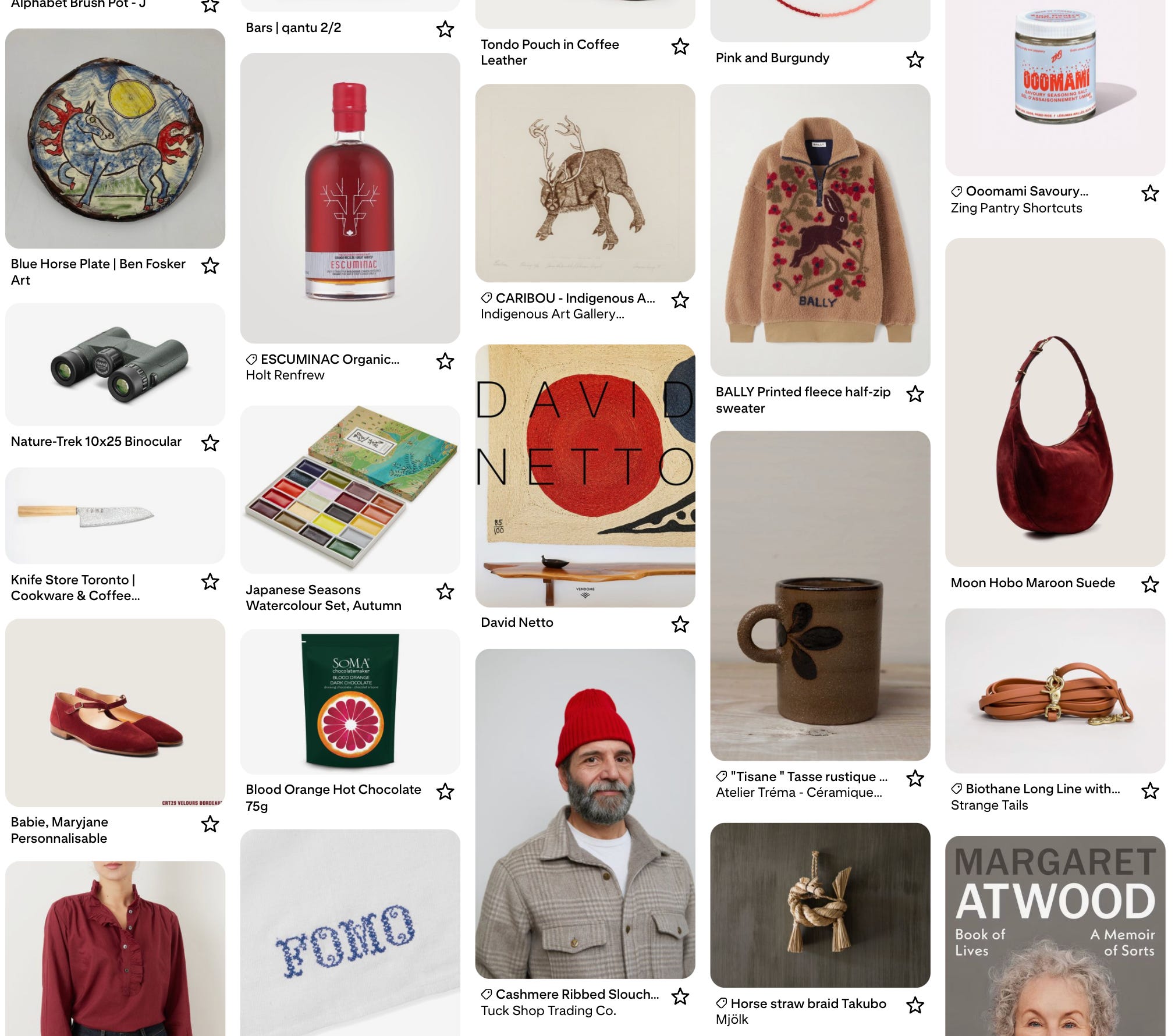
I don’t have just one thing this week. I have over a 100! Yes, it’s gift guide time. Admittedly, some of this is more fantasy than reality, but I have tried to dig up lots of neat Canadian brands (though there’s some requisite ‘homesick for Ireland’ stuff too). Hope you discover something new to you, whether you treat yourself or a loved one! (It’s on my Pinterest, each item clicks to a retailer. No affiliate codes or money-making gimmicks; just me loving to shop.)